REVIEW · MALAGA
Ronda Old Town Walking Tour with Audioguide on Your Smartphone
Book on Viator →Operated by TouringBee · Bookable on Viator
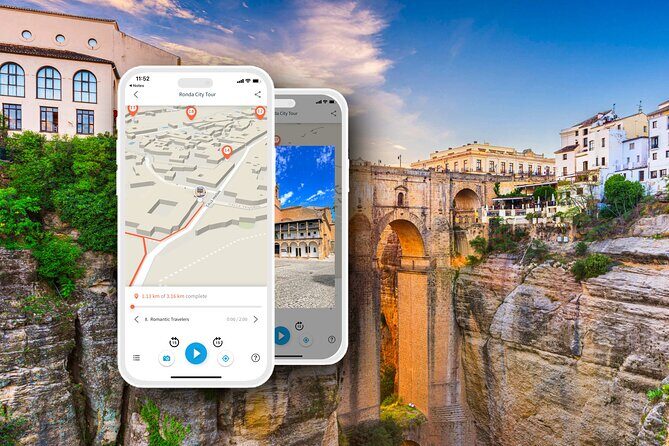
Ronda hits you fast. One walk, and you get gorge views, Moorish traces, and big-city architecture without booking a bus tour. This experience is built around a smartphone audioguide with an offline route map, so you can go at your pace while learning what you’re actually looking at.
I especially love how the stops are practical: you’ll hit classic view points like Balcón del Coño and Puente Nuevo, then shift into quieter history details like the San Sebastián minaret and the Arab Baths. The audio is guided by a professional historian through 21 recordings, which makes even brief stops feel worth your time.
One thing to keep in mind: the experience is self-guided, and the route finish may not line up perfectly with where you parked or started walking from. You’ll want to follow the map on your phone closely before you decide where to leave your car.
In This Review
- Key highlights worth planning for
- Why a smartphone audioguide works so well in Ronda
- Plaza del Socorro: where the walk feels local
- Balcón del Coño: the first big gorge jolt
- Spain Square and the Royal Cavalry bullring area
- Puente Nuevo plus Mirador de Aldehuela: the gorge’s main stage
- Puente Viejo: walk the old bridge for the full rhythm
- Don Bosco House Museum: aristocratic rooms and garden views
- Palacio de Mondragón: Moorish origins, mixed styles, and courtyards
- Santa María la Mayor and the San Sebastián minaret: two faiths, one city
- Church of Santa María la Mayor
- Minaret of San Sebastián
- Lara Museum: the curiosity stop for when you want something weird
- Casa del Rey Moro and the Arab Baths: water, stone, and time
- House of the Moorish King (Casa del Rey Moro)
- Arab Baths (Baños Árabes)
- Almocábar Gate: the old city boundary as your finale
- Price and time: is $6.73 really worth it?
- Who this tour suits best (and who should skip)
- Should you book this Ronda walking tour?
- FAQ
- How long is the Ronda Old Town walking tour?
- Is this a guided tour with a person?
- What language is the audio available in?
- Where does the tour start?
- Do I need headphones?
- Does the route require paid entry tickets?
- Can I cancel and get a refund?
Key highlights worth planning for

- Offline map + GPS route: you can keep moving even if data gets spotty in old-town streets.
- 21 historian audio stops: short, topic-focused segments for each landmark.
- Gorge views built into the walk: Puente Nuevo isn’t just seen once; you get multiple angles.
- Moorish and Christian layers in one route: minaret, baths, palaces, and churches sit close together.
- No human guide needed: less waiting, more control over your timing.
- Limited group size (up to 20): it’s designed to stay manageable.
Why a smartphone audioguide works so well in Ronda
Ronda is a place where you want to pause. One turn can switch you from a sunny plaza to a dizzying drop over the gorge, and then to a stone doorway with centuries behind it. A self-guided audioguide lets you stop when your eyes catch something, not when a group needs to move on.
This tour is priced at $6.73, which is genuinely good value if you’re the type who likes context while walking. Instead of paying for a full guided tour, you’re buying time-saving navigation plus an audio guide app for iPhone and Android, with offline map support and illustrations to help you identify landmarks.
Since there’s no human guide meeting you, you’ll rely on your phone. That sounds obvious, but it’s the key trade-off: it’s flexible, but you must bring your own essentials—especially headphones—and you should plan a few minutes to get the tour activated and running before you start.
You can also read our reviews of more walking tours in Malaga
Plaza del Socorro: where the walk feels local
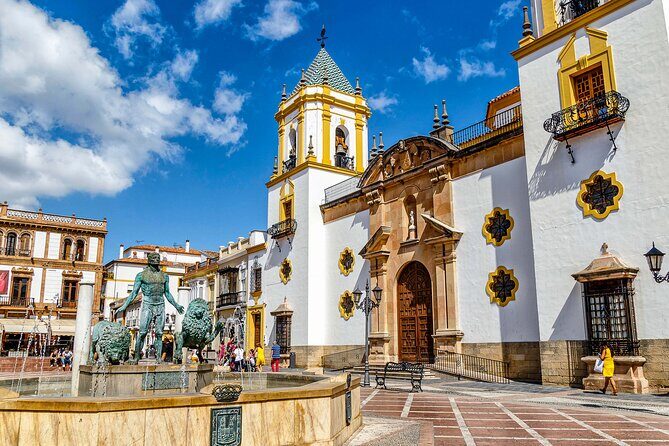
You begin in Plaza del Socorro, the kind of town square where you can blend in quickly. The charm here is simple: historic buildings, everyday cafe life, and a strong sense that you’re stepping into Ronda’s normal rhythm, not a staged tourist route.
This stop also sets you up for the landmarks that follow. You’ll see the Church of Socorro with its striking facade and a fountain featuring Hercules and the Two Lions—symbols tied to Andalusian heritage. Even if you don’t go deep into details at the first minute, it helps you build a mental map of what Ronda is about: stone, story, and strong visual icons.
Practical tip: spend a little time here just to orient yourself. Once you leave the square, the rest of the walk moves quickly from plaza to cliffs to bridges.
Balcón del Coño: the first big gorge jolt
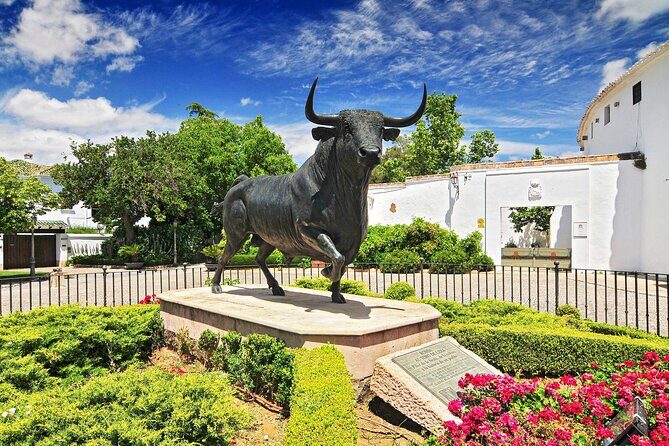
Next comes the viewpoint people talk about for a reason: Balcón del Coño. This is the dramatic edge balcony that looks straight down toward Ronda’s gorge. You’re there for the shock of the scale and for the photos—but also for the feeling that Ronda is built around this drop.
What I like most about starting with this view is the timing. Early on, your brain understands the terrain, so later viewpoints like Puente Nuevo and Aldehuela hit harder. You’ll also get sweeping sightlines across the Serranía de Ronda mountains and the valley below, with Puente Nuevo in the distance.
If you’re sensitive to heights, take it slow. You don’t have to stand right at the edge to appreciate the geometry of the gorge and bridge views.
Spain Square and the Royal Cavalry bullring area
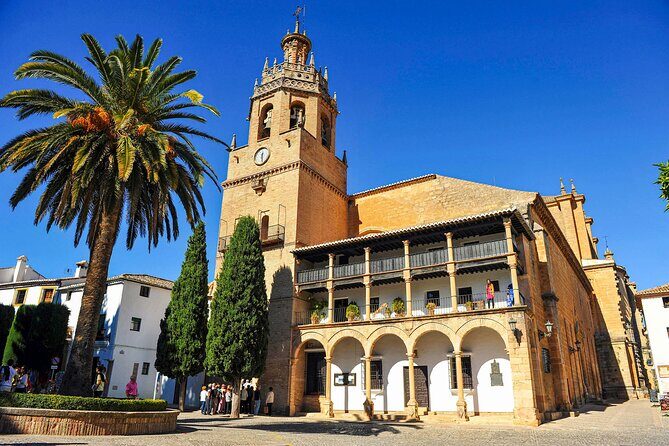
After the cliff views, you shift into a more city-centered scene around Plaza de España. This area acts like a hub for moving through Ronda, with cafes and historic-looking streets feeding the route forward.
From here, you’ll get architectural interest, including the neoclassical facade of the Parador de Ronda, a former town hall. And you’ll spot the iconic Puente Nuevo bridge spanning the gorge, even before you reach the bridge directly.
This stop is a good reminder that Ronda’s beauty isn’t only outside on viewpoints. It’s also in how the city is arranged—squares, pathways, and public buildings that frame the bigger scenery.
Puente Nuevo plus Mirador de Aldehuela: the gorge’s main stage
If Puente Nuevo is the headline, Mirador de Aldehuela is the encore. These two stops work well together because they show different “modes” of the same dramatic space.
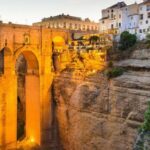
At Puente Nuevo (New Bridge), you’ll see the engineering story and the sheer vertical drop. The bridge was completed in 1793 after 40 years of construction, and you can still feel how long that commitment lasted just by looking at the stone mass and the gorge it crosses. The audio helps you place it as a connector between old and newer towns over the El Tajo gorge, with the Guadalevín River below.
Then Aldehuela gives you a viewpoint perspective tied to bridge design. It’s named after engineer José Martín de Aldehuela, who also designed Puente Nuevo. From this spot, your job is simple: look, absorb the depth of El Tajo, and take in both gorge and river views in one sweep.
Photo tip: don’t just photograph the bridge. Photograph the way the view lines pull your eye—gorge walls, river course, and the bridge as a compositional anchor.
You can also read our reviews of more tours and experiences in Malaga



Puente Viejo: walk the old bridge for the full rhythm
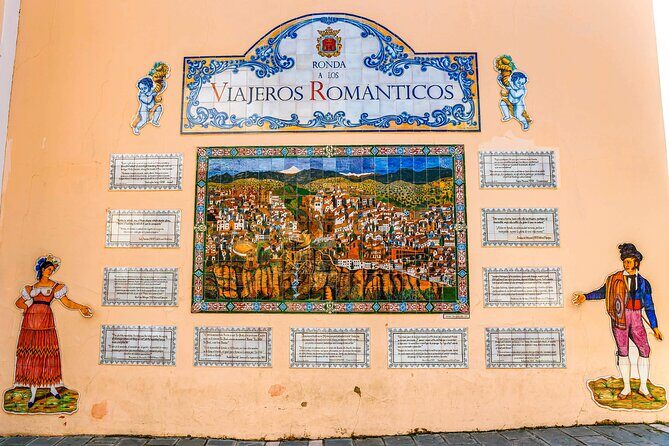
Later, you reach Puente Viejo (Old Bridge), a stone bridge dating back to the 17th century. This is different from Puente Nuevo because you’re no longer only viewing from a high edge. You walk among the arches, and the gorge feels close in a more physical way.
The Old Bridge connects parts of Ronda across the El Tajo gorge, and it gives you a more intimate relationship with the gorge’s scale. You’ll also get another clean view of the Guadalevín River below, with the town’s edges framing the scene.
If you only have time for one bridge moment, choose based on your mood:
- Want awe-from-above? Puente Nuevo and the viewpoints.
- Want to feel the structure under your feet? Puente Viejo.
Don Bosco House Museum: aristocratic rooms and garden views
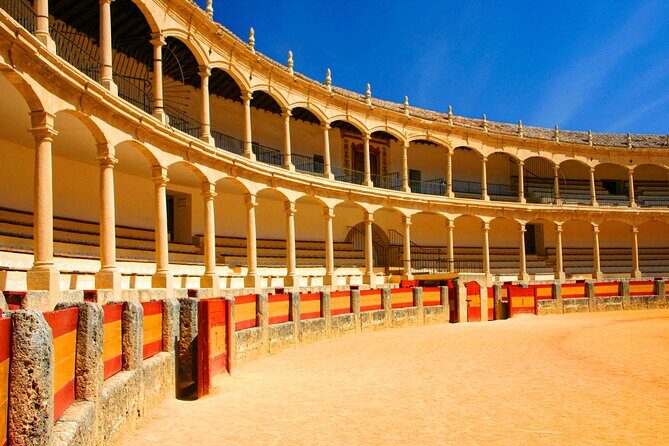
The route then shifts from outdoors to heritage interiors with Casa Museo Don Bosco (Don Bosco House Museum). This early 20th-century mansion offers a glimpse into the lifestyle of a wealthier Ronda family.
What makes this stop worth your time is the contrast. You’re inside rooms with period details, antiques, and intricate azulejo tiles, and then you step out to gardens with fountains and views of El Tajo gorge and Puente Nuevo bridge. It’s the kind of place where the building and the setting work together.
Time consideration: museum moments can quietly expand your total duration, especially if you stop for photos or linger in the gardens. If you have another plan afterward, keep an eye on the time and don’t let one room run long.
Palacio de Mondragón: Moorish origins, mixed styles, and courtyards
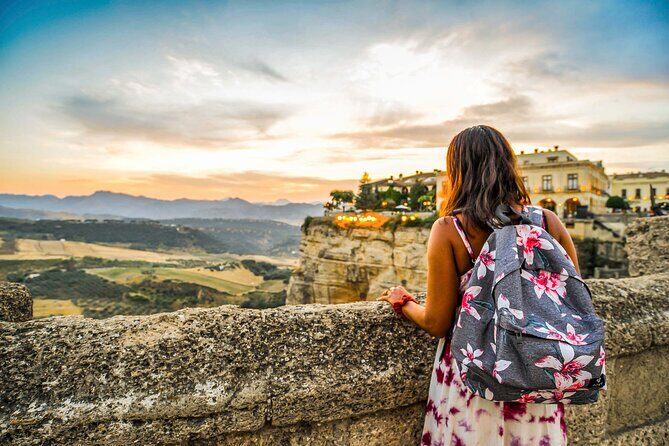
Next is Palacio de Mondragón (Mondragon Palace), tied to Moorish origins and shaped by Renaissance and Mudéjar influences. This palace has multiple layers, and the Municipal Museum setting means you can spend time in the spaces without feeling like you’re rushing a single display.
Expect courtyards, tiled rooms, and gardens, with strong sightlines toward the Serranía de Ronda. The audio here helps you connect style changes with historical shifts—Islamic artistic influences that later coexist with later European design patterns.
What you’ll likely enjoy most: the sense of continuity between decorative details and how people used these spaces. Even if you’re not a museum superfan, it’s one of those landmarks where architecture tells the story.
Santa María la Mayor and the San Sebastián minaret: two faiths, one city
Ronda’s history can feel layered in a very physical way, and these two stops show that directly.
Church of Santa María la Mayor
You’ll visit Iglesia de Santa María la Mayor, known for a blend of Gothic, Renaissance, and Baroque styles. The key detail is the transformation: it began as a mosque after which it became a Christian church after the Reconquista. You can spot that layered past in elements like an intricately carved altarpiece, columns, and a Mudejar coffered ceiling.
There’s also a bell tower perspective mentioned in the audio. Even if you don’t climb for long, it frames the city around you—more than just a church stop.
Minaret of San Sebastián
Then comes the Minaret of San Sebastian, which is one of the most distinctive “visual proof” pieces of Moorish presence. This minaret was originally an ancient mosque tower dating to the Moorish period, later integrated into a Christian church after the Reconquista.
What I like about pairing these stops close together is clarity. Instead of hearing history in abstract terms, you see how the same built form could be re-used across centuries.
Lara Museum: the curiosity stop for when you want something weird
If you’re the type who enjoys odd artifacts and thematic rooms, you’ll probably like Museo Lara (Lara Museum). It’s housed in an 18th-century palace and built around an eclectic collection—antique scientific instruments, vintage firearms, clocks, and ethnographic artifacts.
The audio mentions themed exhibits, including one focused on Witchcraft and the Inquisition, which can turn this stop from “interesting museum” into “wait, what am I looking at?” territory.
Because it’s a museum inside, it can take longer than you expect. If you’re on a tight schedule, treat Lara Museum as the one stop where you set a hard time limit and still get the big picture.
Casa del Rey Moro and the Arab Baths: water, stone, and time
This part of the walk is where the route feels especially memorable, because the sites connect through function and setting.
House of the Moorish King (Casa del Rey Moro)
Casa del Rey Moro sits on the ruins of a Moorish palace. The site combines gardens and an older underground element: you’ll descend into the ancient Water Mine, a labyrinth of steps carved into rock leading toward the Guadalevín River below. Even just understanding that path deep in the stone helps you grasp how people shaped the terrain for everyday life.
The audio also ties the gardens to French architect Jean-Claude Nicolas Forestier, giving you another layer: local history plus later landscape design.
Arab Baths (Baños Árabes)
Then you move to the Arab Baths, described as one of the best-preserved Moorish bathhouses in Spain. Dating to the 13th and 14th centuries, the baths give you a detailed look at horseshoe arches, star-shaped skylights, and intricate brickwork.
This stop is also practical in a history way. You’ll learn how water heating and steam generation worked. It’s not just decorative; it’s design meant for daily routine, social life, and hygiene.
If you like places that show how architecture meets human needs, this is a strong highlight.
Almocábar Gate: the old city boundary as your finale
The route closes with Puerta de Almocábar, a 13th-century fortified gate from the Moorish period. You’ll see the robust stone construction, crenellations, and arches made for defense. It’s a good finish point because it feels like a “limit” you can mentally place around the old town.
If your phone battery is low by this stage, this is still a landmark worth making sure you reach. The audio and illustrations are useful here, but the gate also reads well on its own.
One final practical note from experience: even though the activity states it ends back at the meeting point, your real-world finish can end up slightly off from where you parked or started walking. Check the app route on your phone so you know where you’ll pop out before you commit your car keys or your next transport plan.
Price and time: is $6.73 really worth it?
For about 1 hour 30 minutes, this tour costs $6.73 per person, uses your own smartphone, and provides a self-guided route plus 21 audio recordings. No human guide is included, and you’re not paying for transportation.
That price makes sense if you can do two things:
1) You’re comfortable using your phone on the move.
2) You’re interested in more than just photos—specifically, the bridge engineering, the Moorish-Christian transitions, and the stories behind viewpoints.
Where the value is strongest is in the “bundle” effect. You get navigation support (offline map and GPS route), landmark identification help (illustrations), and historian audio. If you were to recreate that with a map app and separate research, you’d spend more time than the tour takes.
Where it’s less strong is if you hate smartphone hassles. The app must be activated, and you need headphones. If either part goes wrong, the experience becomes less smooth—something you should take seriously before you walk away from your accommodation.
Who this tour suits best (and who should skip)
This works well if you:
- Want to see Ronda’s key sights without waiting for a group.
- Like learning from audio while walking at your own speed.
- Prefer a structured route but still want freedom to linger at viewpoints.
You might want a different option if you:
- Don’t want to manage an app activation on the spot.
- Want a guaranteed end exactly where you started, especially if you’re relying on a specific parking area.
- Plan to do multiple paid attractions in one day and need a fully escorted schedule.
Should you book this Ronda walking tour?
Yes, you should book it if you’re doing a day trip and want a smart way to connect the main views with the layered history. The price is low enough that you’re not taking a big financial risk, and the audio format makes the time feel efficient.
But book with a small checklist:
- Bring headphones and make sure you have enough battery.
- Start early enough that you can handle a quick activation step.
- Before you begin, open the in-app map and confirm your route sequence, including where you’ll finish relative to your parking plan.
If you do those things, you’ll get a smooth walk through Puente Nuevo’s world, Ronda’s Moorish remnants, and some quietly surprising museum moments—all on your schedule.
FAQ
How long is the Ronda Old Town walking tour?
It’s about 1 hour 30 minutes.
Is this a guided tour with a person?
No. It’s self-guided, so there’s no human guide at the meeting point.
What language is the audio available in?
The audio guide is offered in English.
Where does the tour start?
The start is Plaza del Socorro (Pl. del Socorro, 29400 Ronda, Málaga, Spain).
Do I need headphones?
Yes. Headphones and a smartphone are not included, so you’ll need to use your own.
Does the route require paid entry tickets?
The tour states that no routes require an entry fee. Entrance fees/tickets are listed as not included, so if a site requires payment during your visit, you’d need to cover it separately.
Can I cancel and get a refund?
You can cancel for a full refund if you cancel at least 24 hours in advance. If you cancel less than 24 hours before, the amount paid is not refunded.